
KZ Audio & Video · San Antonio · Since 1999
Where Do You Place Surround Sound Speakers?
- Since 1999
- In the Audio Business
- Free Consult
- No Pressure, No Pitch
- Clean Install
- We Leave It Like We Found It
- 5.0 Stars
- 34 Google Reviews
Quick Answer
Surround sound speaker placement follows Dolby and THX standards based on your listening position. Front left and right speakers: place at ear height, 22–30° off-center from your seat. Center channel: directly above or below the screen at ear height, never higher or lower than 15° from eye level. Surround speakers (5.1): 90–110° to the side of your seat, slightly above ear height (2 feet above). Rear surrounds (7.1): 135–150° behind the listening position at the same height as the side surrounds. Dolby Atmos height speakers: mounted in the ceiling at 45° in front of and behind the listening position, or angled upward from the front left/right positions. Subwoofer: start at a front corner and adjust from there, subwoofer placement is the most room-dependent variable in the system. Correct placement matters more than speaker brand for most rooms.
Written by Kelly Zauber · KZ Audio & Video · San Antonio, TX · (210) 981-4098
Front Left, Center, and Right: The Most Important Speakers
About 70% of a movie's audio plays through the front three speakers. Getting these right is more important than anything else in the system.
- Front L/R: Place at ear height when seated (tweeter at ear level). Angle 22–30° off-center axis. For in-wall speakers, this is typically the left and right edges of the TV wall. For floor-standing or bookshelf, place 3–6 feet from center.
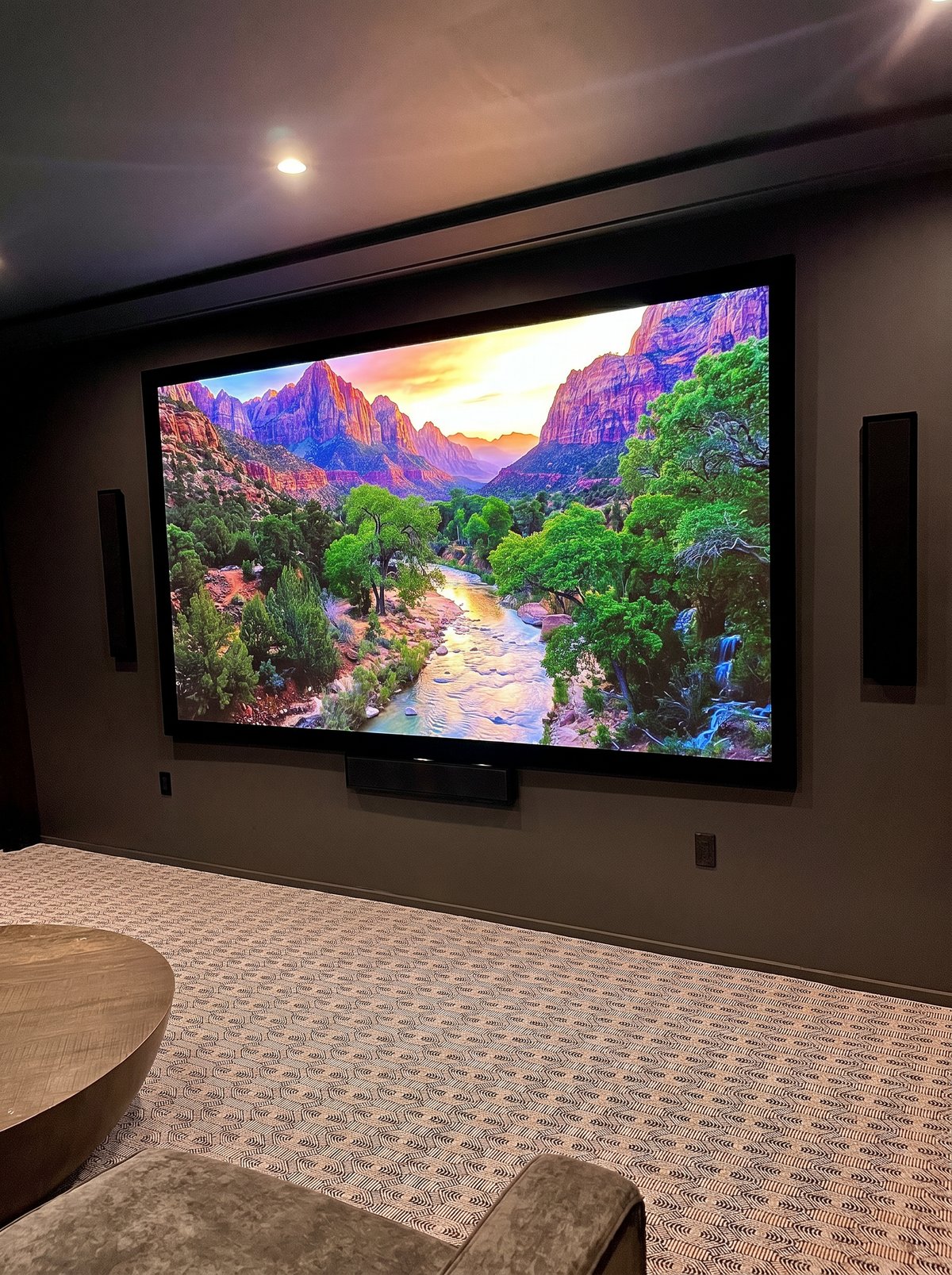
- Center channel: Directly above or below the TV or screen, within 15° of eye level. This is non-negotiable, dialogue that comes from too high or too low sounds unnatural and fatiguing. For projector screens, we often use an acoustically transparent screen with the center speaker behind it.
Surround Speakers, 5.1 Layout
In a 5.1 system, the two surround speakers go to the sides of the listening position:
- Position: 90–110° from the front-center axis (directly to the side or slightly behind)
- Height: 2 feet above seated ear height, roughly 6–7 feet off the floor for most rooms
- Aim: Point them toward the listening position, not at the wall
In a living room where speakers go on the side walls, in-wall surrounds at 6–7 feet height work well. In a dedicated theater with rows of seating, dipole or bipole speakers spread sound more evenly across multiple rows.
Rear Surrounds, 7.1 Layout
The rear channels in a 7.1 system handle sounds that pass behind you: helicopter flyovers, crowd noise, environmental ambience.
- Position: 135–150° behind the primary listening position
- Height: Same height as the side surrounds (6–7 feet)
- Note: In a small room (under 14 feet deep), rear surrounds are often cramped and a well-placed 5.1 sounds better. Add rear channels only if you have the room for them to work.
Dolby Atmos Height Speakers
Atmos adds overhead sound for a three-dimensional soundstage. Three placement options:
- In-ceiling (best): Speakers mounted 45° in front of and 45° behind the listening position. For a single row of seats, two pairs (four speakers) give you a proper 7.1.4 layout.
- Upward-firing modules: Placed on top of the front L/R speakers, angled toward the ceiling. A compromise that works reasonably well in rooms where ceiling installation is not possible.
- Enabled speakers: Front-firing speakers with an upward-angled driver. The weakest option, works in small rooms, struggles in larger spaces or rooms with vaulted ceilings.
Subwoofer Placement
Bass is omnidirectional, you cannot hear where a subwoofer is. What you can hear is room modes (bass buildup or cancellation at certain spots). Start with the subwoofer in a front corner and run the receiver's auto-calibration (Audyssey, YPAO, MCACC). If bass is boomy or one-note, move it. The "subwoofer crawl": putting the sub in your listening seat and walking the room while playing a bass-heavy track until you find the tightest, most even bass, then placing the sub where you stood, is a real technique that works.
Room Shape Exceptions
L-shaped rooms, open floor plans, and rooms with glass walls on one side all require adjusted placement. In an open-plan living room, side surrounds often have to go closer to 70–80° because the walls are not where the geometry assumes they will be. A free in-home consultation lets us map the room before specifying any speaker positions.
Pro Tip: From 25+ Years of Installs
The biggest placement mistake we see is putting surrounds in the ceiling directly above the listening position. This is for Atmos height, not surround channels. Surround speakers belong to the sides and rear at ear-to-slightly-above-ear height. Ceiling surrounds directly overhead give you no left-right localization for side effects and make dialogue feel disembodied.
San Antonio & Hill Country Context
Hill Country custom homes frequently have vaulted ceilings of 18–24 feet and open floor plans that extend into kitchens and dining rooms. These spaces require specialized speaker placement: often a combination of in-wall surrounds, distributed ceiling speakers for the overflow area, and precise subwoofer positioning to prevent bass from disappearing into the open space. We measure every room before specifying a single speaker location.
KZ Audio & Video installs throughout San Antonio, Stone Oak, Boerne, Helotes, Canyon Lake, New Braunfels, and the Texas Hill Country. Book a free consultation →
Explore KZ Services & Pricing
Need a Real Answer for Your Room?
Every room is different. Kelly has been solving AV problems in San Antonio homes since 1999. Free in-home consultation: we come to you, assess the space, and give you a written quote.
Serving San Antonio · Boerne · Canyon Lake · New Braunfels · Hill Country