
KZ Audio & Video · San Antonio · Since 1999
How Can I Make My TV Sound Better?
- Since 1999
- In the Audio Business
- Free Consult
- No Pressure, No Pitch
- Clean Install
- We Leave It Like We Found It
- 5.0 Stars
- 34 Google Reviews
Quick Answer
The fastest way to improve TV sound is to add a soundbar: even a $300 model sounds dramatically better than any built-in TV speaker, because TV speakers are physically small, face the wrong direction, and lack bass response. A soundbar with a wireless subwoofer ($400–$900) is the most practical upgrade for most living rooms. If you want a significant step up from a soundbar, a 5.1 surround sound system ($1,800–$4,000 installed) delivers a fundamentally different listening experience with real speakers placed around the room. Before spending anything, try these free steps first: turn off TV dynamic compression settings, enable "movie" or "cinema" audio mode, and enable eARC if your TV and soundbar both support it. On most TVs, these settings alone make a noticeable difference. Built-in TV speakers are limited by physics, the enclosure is too thin and the drivers are too small to produce real bass or stereo separation, regardless of how the equalizer is set.
Written by Kelly Zauber · KZ Audio & Video · San Antonio, TX · (210) 981-4098
Free Fixes First: Try These Before Buying Anything
- Disable dynamic compression: Found in Audio Settings as "Volume Leveling," "Auto Volume," or "Sound Normalization." This setting reduces loud moments and boosts quiet ones. It makes everything sound flat. Turn it off.
- Switch to Cinema or Movie mode: Most TVs have preset audio modes. The default (Standard or Normal) is heavily processed. Cinema or Movie mode is flatter and more accurate for films and TV.
- Enable eARC: If you have a soundbar connected via HDMI, make sure eARC is enabled on the TV's HDMI output. eARC carries high-quality audio including Dolby Atmos and DTS-HD. The older optical connection does not carry these formats.
- Disable "dialogue enhancement" and "virtual surround": These processing modes often make dialogue sound thin or hollow. A real speaker placed correctly does more for dialogue clarity than any digital processing.
Soundbar: The Most Practical Upgrade
A soundbar is the right upgrade when you want meaningfully better sound without wires, multiple speakers, or a receiver. The sound improvement over built-in TV speakers is immediate and significant, not subtle. Budget guidance:
| Budget | What You Get | Best For |
|---|---|---|
| $200–$400 | Quality soundbar, no sub or basic sub | Bedroom, office, secondary TV |
| $400–$900 | Soundbar + wireless subwoofer | Living room, casual viewing |
| $900–$1,500 | Premium bar with virtual Atmos, better sub | Main living room, movie watching |
| $1,500+ | Flagship soundbar (Sonos Arc, Sony HT-A7000) | Living room where full surround is not wanted |
AV Receiver + Separate Speakers: The Real Step Up
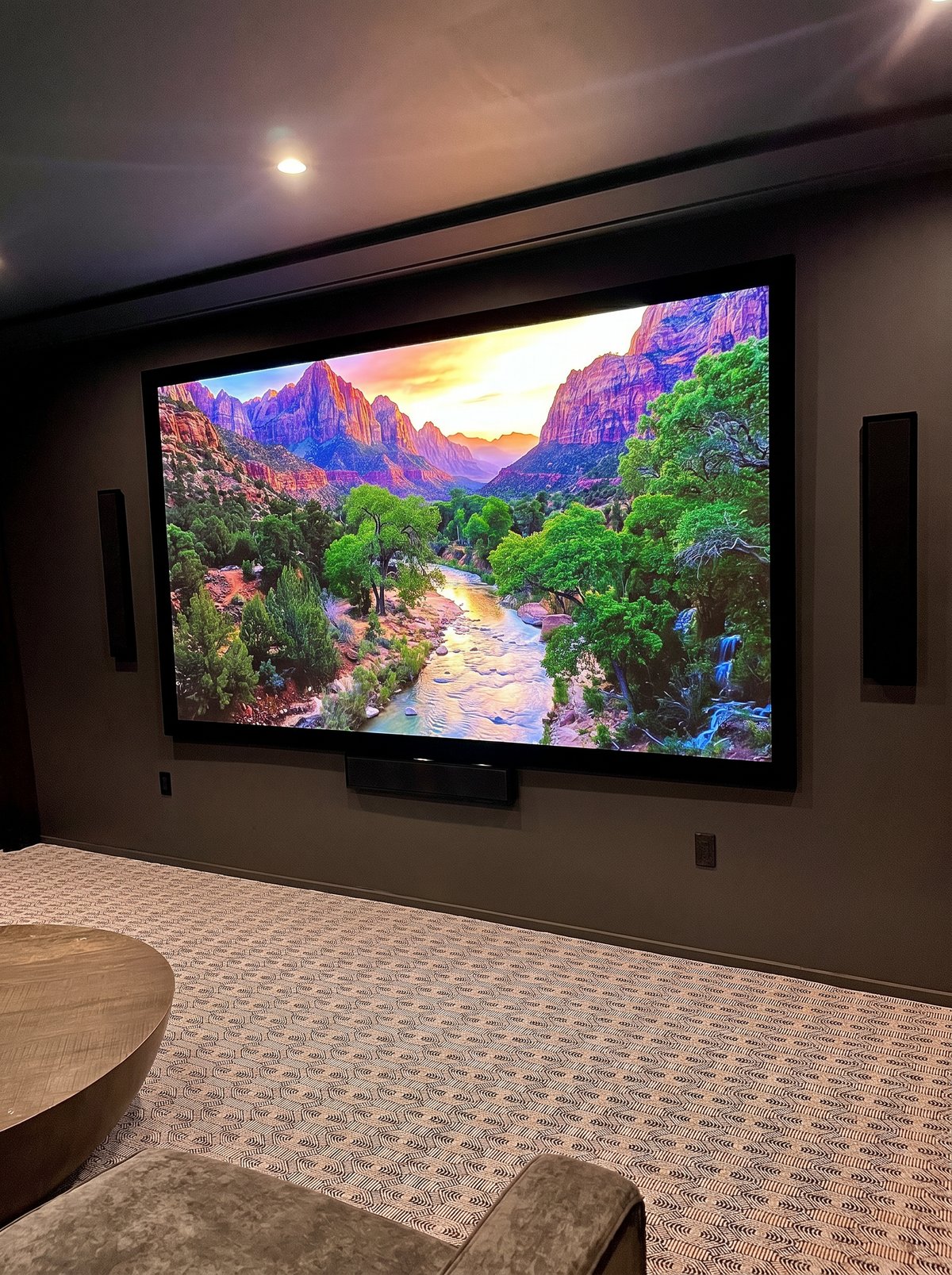
If you want sound that genuinely rivals a movie theater, a soundbar is not the path. It is a ceiling, not a door. An AV receiver paired with separate speakers (floor-standing or bookshelf fronts, a center channel, surround speakers, and a subwoofer) creates a 5.1 or 7.1 system where each speaker is placed exactly where the audio engineer intended when they mixed the film.
A proper 5.1 system starts around $1,800 installed and delivers an experience that no soundbar at any price replicates. This is the right answer for anyone building or finishing a media room.
Speaker Placement Matters More Than Equipment
A $600 surround system placed correctly: center at ear height, surrounds at 90° to the sides at 6–7 feet, sounds better than a $2,000 system placed randomly. The most common placement mistake is putting the center channel too high (above the TV when the screen is already at 5 feet) and surrounds on the back wall instead of the side walls. Correct this before upgrading any equipment.
Calibration: The Free Improvement Nobody Does
Every AV receiver includes an automatic calibration system (Audyssey, YPAO, AccuEQ, or similar). Run it: it uses a microphone to measure your room and adjusts speaker levels, distances, and EQ automatically. Most systems ship with default settings that assume a generic room. A calibrated system in a real room sounds significantly better than an uncalibrated one.
Pro Tip: From 25+ Years of Installs
The single most underrated upgrade is a dedicated subwoofer. Most built-in TV speakers roll off below 100Hz. You are missing everything below that frequency. Adding even a modest powered subwoofer ($200–$400) and crossing it over at 80–100Hz transforms the perceived size and weight of the sound. You feel it physically, not just hear it. This is the change that makes people stop and say "what did you do?"
San Antonio & Hill Country Context
San Antonio living rooms in newer construction often have open floor plans that bleed sound into kitchens and dining areas, a soundbar pointed at one wall loses half its energy into the adjacent space. In these rooms, in-ceiling speakers paired with a compact amp or a Sonos system solve the problem that a soundbar cannot: coverage across the whole open area without cranking the volume. We design these setups constantly in Boerne and Stone Oak new builds.
KZ Audio & Video installs throughout San Antonio, Stone Oak, Boerne, Helotes, Canyon Lake, New Braunfels, and the Texas Hill Country. Book a free consultation →
Explore KZ Services & Pricing
Need a Real Answer for Your Room?
Every room is different. Kelly has been solving AV problems in San Antonio homes since 1999. Free in-home consultation: we come to you, assess the space, and give you a written quote.
Serving San Antonio · Boerne · Canyon Lake · New Braunfels · Hill Country